

Earning on Instagram: the follower count question, answered
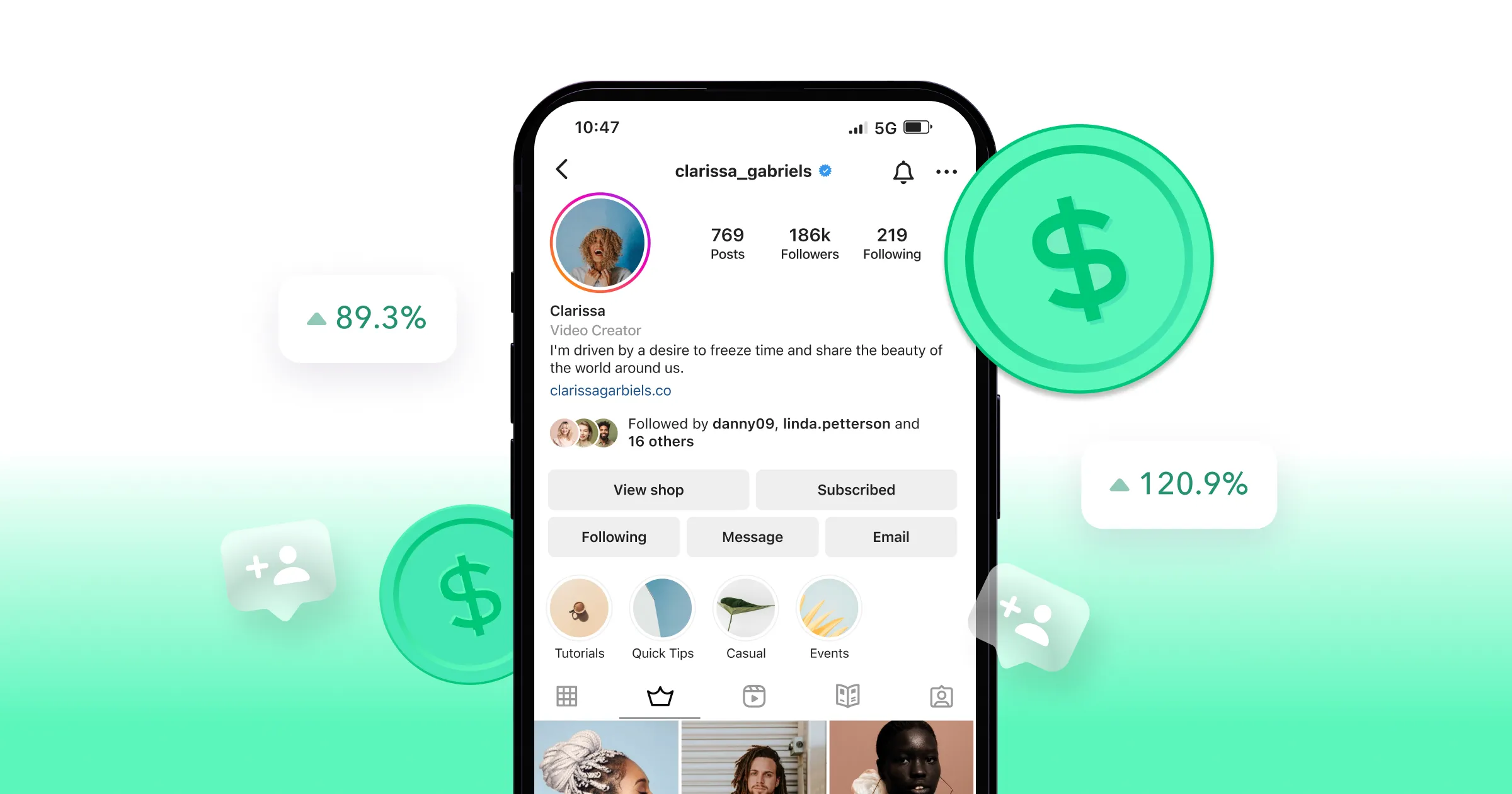
If you're trying to figure out when your Instagram account can actually start generating income, you're asking the right question. But you're probably expecting a cleaner answer than you'll get.
The honest truth: there's no magic number. Creators with 2,000 followers can earn money on Instagram. So can creators with 2 million. What matters is less about your follower count and more about your engagement, your niche, and how you choose to monetize. Here's how it actually works.
How do creators make money on Instagram?
Before getting into follower thresholds, it helps to understand the different ways people actually earn on the platform. Instagram isn't one income path. It's several.
Sponsored posts and brand deals are the most talked-about path, and for good reason. A brand pays you to feature their product or service in your content. Rates vary enormously depending on your niche and engagement, not just your follower count.
Affiliate marketing is another option that works at almost any follower count. You share a special link or promo code, and when your followers buy through it, you earn a commission, typically 5-20% depending on the program. The key is having an audience that actually engages with what you post.
Instagram also has a few built-in ways to earn directly. Subscriptions let followers pay a monthly fee for exclusive content. You'll need 10,000+ followers and a Professional (Creator or Business) account to access this. Live Badges work similarly: viewers buy badges during your live streams to support you, and that also requires 10,000+ followers and a Professional account. There are also invitation-only Reels bonuses that Instagram pays out based on video performance.
Selling your own products or services, whether physical products, digital downloads, courses, coaching, or freelance work, doesn't require any follower minimum. It just requires the right audience. The same goes for content licensing, where brands and media companies pay to use your photos or videos in their own marketing. Even smaller creators with strong visual content can earn this way.
Instagram doesn't pay creators per view or per like outside of select invitation-only bonus programs. Most creator income comes from brand partnerships, affiliate commissions, Subscriptions, and Live Badges, not from Instagram paying you directly for views or engagement.
How many followers do you actually need?
Here's how earnings realistically break down by tier:
At 1,000-10,000 followers (nano-influencer), affiliate marketing and product sales are your best bets. Some small or local brands work with nano-influencers, especially when the niche is tight and engagement is strong. Instagram's native gifting on Lives also becomes available at 1,000+ followers. Brand sponsorship deals typically start becoming realistic around 5,000-10,000 followers, depending on your niche.
What matters most at this stage isn't follower count. It's engagement rate. A creator with 3,000 highly engaged followers in personal finance can be worth more to the right brand than someone with 50,000 passive followers in a saturated lifestyle niche.
At 10,000-100,000 followers (micro-influencer), you hit the sweet spot for a lot of brands. Micro-influencers tend to have more dedicated, trusting audiences than larger accounts, and they're more affordable. Instagram Subscriptions and Live Badges become available here too. According to Lumanu's 2025 analysis of over $1 billion in creator payouts, micro-influencers in this range averaged $38,500 in annual earnings, with about 30-40% of that coming from fan monetization like subscriptions and tipping rather than brand deals alone.
At 100,000-1,000,000 followers (mid-tier), brand deals become more structured and consistent. You're likely being approached by brands rather than pitching them. Flat-rate sponsorship deals replace commission-based arrangements, and rates typically range from $2,000 to $15,000+ per post.
At 1,000,000+ followers (macro/celebrity), you're negotiating contracts, not filling out brand forms. Rates can reach $25,000-$100,000+ per post for the right fit, and most creators at this level have a team helping manage it.
What actually moves the needle
There's no universal formula for hitting $1,000 a month on Instagram. Many micro-influencers in the 10,000-50,000 range get there by combining brand deals, affiliate income, and selling their own products or services. It depends more on your monetization mix than your follower count.
The factors that actually drive earning potential are pretty consistent across every tier. Engagement rate matters more than follower count to most brands. Comments, saves, shares, and link clicks signal that your audience actually listens to you. A 15,000-follower creator with a 12% engagement rate can outperform a 200,000-follower account with 0.8% engagement when it comes to driving real results for a brand.
Niche affects your rates at every level. High-value niches, like personal finance, B2B tools, health, and real estate, consistently command higher rates than consumer lifestyle or entertainment, where there's more competition and lower average pay-per-post.
What matters more than follower count is content quality. Well-edited video is what attracts better-paying brands and signals professionalism, regardless of how big your audience is. Being able to post consistently also signals reliability to brands looking for ongoing partnerships, and it builds the audience trust that makes all of this work long-term.
The good news: the right tools make both a lot more manageable. Captions uses AI to help you edit and produce high-quality videos faster, so you're not choosing between posting often and posting well.